What is a nonprofit website redesign?
A nonprofit website redesign is the process of improving a nonprofit’s website’s structure, content, design, functionality, and performance to better serve its audience and organizational goals. A typical redesign includes strategy and discovery, content and UX planning, design and development, SEO protection, testing, and launch

The Nonprofit Website Redesign Process at a Glance
A nonprofit website redesign typically involves:
- Initial consultation: Establish goals, timeline, budget, and decision-makers.
- Strategy and discovery: Audit the existing website, content, SEO, analytics, and relevant marketing data.
- Planning: Conduct discovery workshops and define the project’s scope, timeline, and deliverables.
- Content and UX: Develop website copy, wireframes, information architecture, and visual direction.
- Design and development: Build the new website around the approved structure and content.
- SEO and testing: Protect existing search visibility, map redirects, and test the site across devices.
- Launch and training: Launch the website, complete the handoff, and train your team to manage it.
At Embark, those steps are organized into four phases.
Phase 1: Initial Consultation and Project Fit
Our first step is a 30 minute conversation.
Before anything else, we spend time getting to know your organization — your goals, your timeline, your budget, and who on your team has the authority to make decisions. We’re also figuring out whether we’re the right fit for each other. This call goes both ways. We’re evaluating whether we can genuinely serve your needs as much as you’re evaluating whether we’re the right partner.
If we’re not the right agency for your project, we’ll tell you honestly. If we are, we move to the next step.
Phase 2: Strategy and Discovery
This is the strategic phase, and it’s the one that separates a redesign that performs from one that just looks different.
For Embark, this stage is a paid engagement that covers everything we need to understand before a single design decision is made. Throughout this entire phase, you’re working directly with our principal strategist.
The Audit
We start by looking at everything you already have. Website traffic, existing content, current SEO performance, site structure, what’s working and what isn’t. We also look at your CRM, your donor data where relevant, and any marketing channels you’re currently running. A lot gets decided here about what needs to stay versus what needs to go. That conversation is almost always more nuanced than clients expect going in.
The Workshops
From the audit we move into working sessions. At least two collaborative discovery workshops where we explore your organization, your audience, how you want to grow, and what success actually looks like at the end of this project. These are not presentations. They’re working conversations. The goal is to find the gap between where you are and where you need to be and to make sure everyone on your team is aligned on that before we go any further.
When National Catholic Youth Conference (NCYC), the largest Catholic youth event in the country, came to Embark needing to reach an entirely new west coast audience for the first time, this strategic groundwork was what made everything that followed possible. We understood the audience, the mission, and what the website needed to accomplish before a single page was built.
The Proposal
Everything from the audit and workshops feeds into your proposal. Not a generic quote with line items pulled from a template, but a real scope of work built entirely on what we’ve learned about your organization — deliverables, timeline, and projected cost. This is also where we make early decisions about your broader digital strategy: whether SEO and AEO optimization should be integrated into the build, whether paid advertising makes sense for your goals and budget, and what ongoing support looks like after launch.
Once you sign off on the proposal, we begin building in Phase 3.

Phase 3: Website Content, Design, and Development
Phase 3 is everything between proposal approval and launch. This is where the rest of the Embark team gets involved and most of the visible work happens.
Moodboards
Before any design begins, we establish the visual direction through moodboards. This gives you a chance to react to look and feel early — when changes are easy and inexpensive — rather than after a full design has been built. Getting visual alignment here saves significant time later and prevents the painful back-and-forth that happens when aesthetic direction is left undefined too long.
Wireframes
A wireframe is a simplified version of a webpage that focuses on structure rather than visual design. There are no final colors, fonts, or images yet. Instead, we use wireframes to determine how content will be organized and how visitors will move through the site. We do this early in development to identify any structural problems before they become expensive to fix
Website copy
Copy gets written before design begins, not after. This is one of the most common places nonprofit redesigns go wrong. When copy is treated as an afterthought it gets squeezed into a template that wasn’t built for it. We write or refine your website copy during this phase so that the design is shaped around your actual words and message, not the other way around.
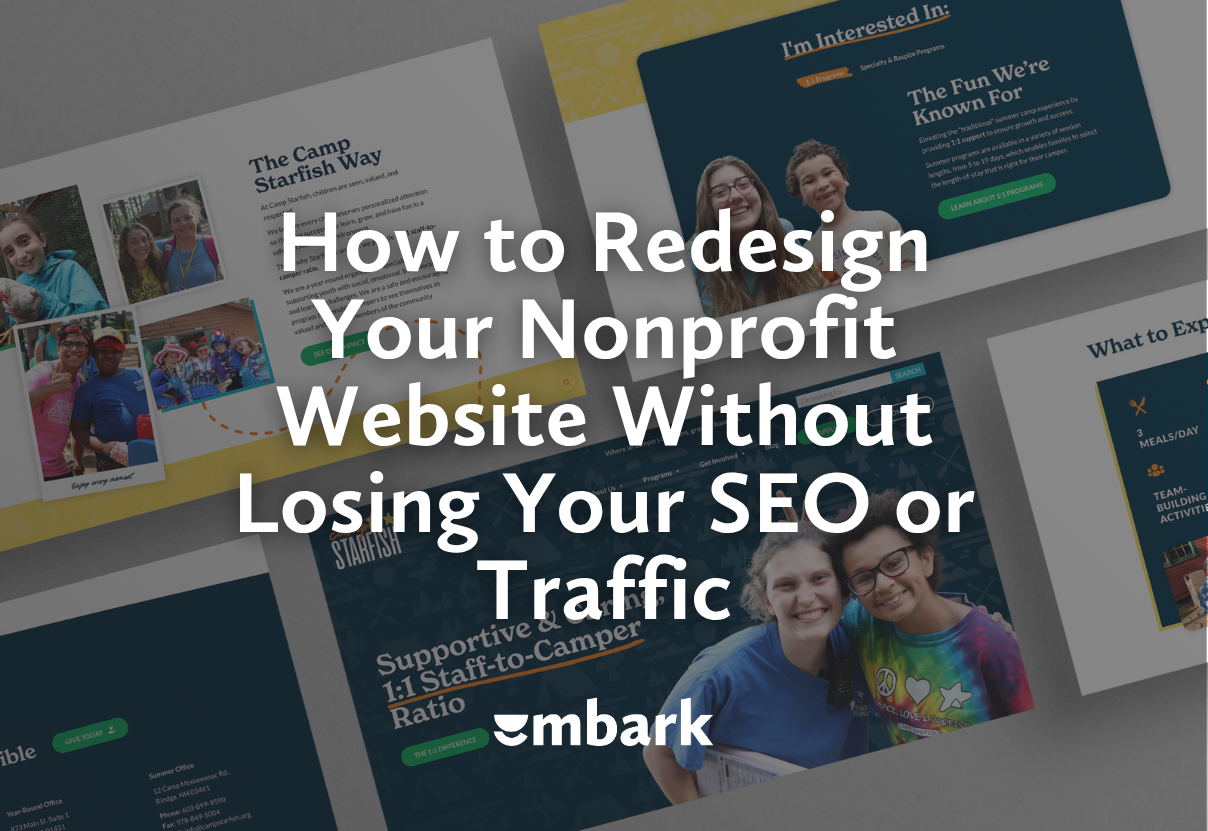
Where needed, this also includes developing a brand voice guide: a document that defines how your organization sounds in writing so that everything from the homepage to the donation confirmation email feels consistent. For Camp Starfish, a nonprofit serving children with special needs, this kind of brand clarity was central to the work, and part of what earned Embark a Transform Award (Silver) for Best Visual Identity by a Charity, NGO, or NFP, the only awards program dedicated to celebrating brand transformation.
Design and new visual elements
With copy and wireframes in place, full design begins. This includes new visual elements such as photography direction, iconography, graphic assets are developed to match the moodboard direction established earlier. Every visual decision at this stage has a reason behind it.
Biweekly check-ins
Throughout Phase 3, we run biweekly calls with your team. Not just a kickoff meeting and a final reveal — regular touchpoints so nothing surprises you at the end. One of our clients put it simply: “They invested time upfront to understand our mission and how it related to the broader community we serve.” That kind of ongoing communication is built into the process by design.
Phase 4: Website Launch, SEO, and Handoff
When everything is built, reviewed, and approved, we launch. But The Launch isn’t just hitting publish.
It includes final SEO and AEO checks, redirect mapping if URLs are changing, speed and mobile testing across devices, and a complimentary 45-minute training session so your team can manage the site independently from day one.
Many of our clients continue working with Embark after launch on ongoing strategy, content, and marketing support. What that looks like gets defined during our strategy calls in Phase 2, so there are no surprises.
The results speak to what this process makes possible. After Embark built and launched the NCYC website and ran a full marketing campaign around it, NCYC saw 70% more users to the site and a 340% increase in engagement time compared to the previous period

How Does a Website Redesign Affect SEO?
A nonprofit website redesign can affect SEO because changing a site’s structure, content, or URLs can also change how search engines understand and rank its pages.
Protecting existing search visibility requires intentional planning before launch. That can include:
- Auditing existing content and rankings
- Identifying high-performing pages
- Preserving valuable content where appropriate
- Reviewing the site’s information architecture
- Mapping old URLs to new URLs
- Setting up redirects when URLs change
- Creating or updating the XML sitemap
- Checking important pages after launch
A redesign is also an opportunity to improve the site’s ability to appear in search results and AI-generated answers. Clear site structure, useful content, strong page-level answers, and well-organized information can all help search engines and AI systems better understand an organization and its website.
SEO shouldn’t be something added after the new design is finished. It should be considered while the site is being planned.

What Should a Nonprofit Website Include?
There’s no single list of pages every nonprofit needs. The right website structure depends on the organization’s mission, audience, programs, and goals.
Most nonprofit websites need to make several things easy for visitors to find:
- Clear understanding of mission
- Who the nonprofit serves
- Why the work matters
- Programs or services
- Ways to donate or support the mission
- Ways to volunteer or get involved
- Events and important updates
- Contact information
- Resources or educational content, when relevant
A nonprofit website also needs to work well on mobile devices, be accessible to as many visitors as possible, and give the organization’s team a practical way to manage its content.
The redesign process is an opportunity to determine what belongs on the site, where it belongs, and how visitors should move through it.
How Much Does a Nonprofit Website Redesign Cost?
There’s no universal price for a nonprofit website redesign. We have worked on projects starting at $5,000 to over $100,000.
The cost depends on factors such as the size of the website, number of pages, content needs, functionality, integrations, SEO requirements, and how much strategy or ongoing support the organization needs.
A small nonprofit website with a straightforward structure will have different requirements from a large organization with extensive content, multiple programs, donor functionality, or complex integrations.
At Embark, we determine the scope and projected cost during our strategy sessions in Phase 2, after we’ve had the opportunity to understand the organization’s goals and existing digital presence.
How Long Does a Nonprofit Website Redesign Take?
Most nonprofit website projects at Embark take four to six months from signed proposal to launch.
The timeline depends heavily on the organization’s size, content requirements, internal decision-making process, and how quickly the team can provide feedback and approvals.
The strategic phase also happens before the build begins. That means the timeline isn’t simply the amount of time it takes to design and develop the website. It includes the work required to make the right decisions before development starts.
Organizations that come into the project with clear goals and the right decision-makers involved tend to move more efficiently.

How Do You Know If Your Nonprofit Needs a Website Redesign?
A nonprofit doesn’t necessarily need a full redesign just because its website looks dated.
Sometimes a refresh is enough. A refresh might address outdated visuals, messaging that needs to be updated, or a donation path that could be easier to use.
A full redesign becomes more relevant when the underlying website structure is the problem.
Signs that it may be time for a redesign include:
- The website no longer reflects how the nonprofit has grown
- The website is difficult for your team to manage
- Visitors struggle to find important information
- The website doesn’t work well on mobile devices
- The site can’t support new content, programs, or functionality
- The current platform is too limiting in making significant improvements
- The website isn’t supporting current marketing and development goals
- SEO performance is not meeting expectations
- The website requires repeated fixes without addressing the underlying problems
If you’re unsure whether you need a refresh or a full redesign, that evaluation should happen before the project begins.
What Is the Difference Between a Website Refresh and a Redesign?
A website refresh typically focuses on targeted improvements to an existing site. That might include updating the visual design, revising messaging, improving specific pages, or simplifying a conversion path.
A website redesign is broader. It may involve restructuring the site’s navigation, rewriting content, creating a new information architecture, changing the visual system, improving the user experience, rebuilding templates, or moving to a different platform.
The right choice depends on what’s actually causing the website’s problems.
Read More Here: Does My Nonprofit Actually Need a Website Redesign?
Frequently Asked Questions
What should a nonprofit prepare before starting a website redesign?
The most valuable things to have ready are clarity on your goals — what the website needs to accomplish, not just what it should look like — and the right people in the room during the strategic phase. Embark’s discovery process is designed to draw this out even when it isn’t fully formed yet, but organizations that have done some internal alignment before the process begins move significantly faster.
What happens to our SEO during a website redesign?
SEO protection during a redesign requires intentional work upfront: auditing existing content and rankings before anything changes, mapping current URLs and setting up proper redirects before launch, preserving high-performing pages wherever possible, and submitting an updated sitemap immediately after launch. These aren’t afterthoughts — they’re built into Embark’s process from the beginning.
How do I know if my nonprofit needs a full redesign or just a refresh?
A refresh may be enough when the site’s underlying structure works but the visuals, messaging, or specific user experiences need improvement. A redesign is more appropriate when the site’s structure, platform, content organization, or functionality is no longer meeting the organization’s needs.
What happens after a nonprofit website launches?
After launch, the organization’s team should have the access and training needed to manage the website. At Embark, clients receive a 45-minute training session and own the website and its assets outright. Some organizations also continue with ongoing strategy, content, and marketing support.

A Website Redesign Should Solve a Core Problem
A nonprofit website redesign shouldn’t be about making an old website look new.
The goal is to build a website that makes it easier for the right people to understand your organization, find what they need, take action, and stay connected to your mission.
That’s why the most important work often happens before the first page is designed.
At Embark, the four-phase process is designed to make those decisions early, so the website you launch is built around where your organization is going next.